 Home
Home Recipes
 Beans
Beans Gear
Gear Roasting
 Brewing
 FAQ
FAQ

Definition
Coffea racemosa, commonly known as Racemosa coffee or “Inhambane coffee,” is a drought-resistant wild coffee species native to coastal East Africa, particularly Mozambique, characterized by its small beans, low caffeine content, and unique flavor profile with pronounced sweetness and citrus notes.
Description
Racemosa coffee is indigenous to the coastal regions of East Africa, primarily Mozambique, as well as parts of Tanzania and South Africa. Unlike most commercial coffee species that thrive in highland environments, Racemosa has adapted to grow in sandy soils and lower altitudes, often found in coastal forests and woodlands at elevations from sea level to about 600 meters (2,000 feet).
The Racemosa plant is typically a compact shrub or small tree reaching heights of 1.5-4 meters (5-13 feet). It features glossy, round to oval leaves that are smaller than those of Arabica. One of its distinctive characteristics is its remarkable drought resistance, with the ability to survive extended dry periods of 5-6 months—a trait that has drawn increasing attention as climate change affects traditional coffee-growing regions.
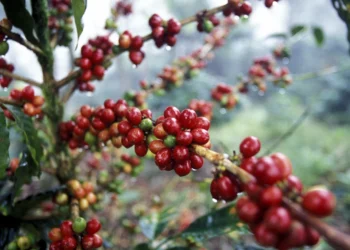
The cherries are small and ripen to a bright red color, containing small, rounded beans. The plant gets the name “racemosa” from its flowering pattern, where flowers grow in racemes (flower clusters with a single unbranched axis).
Racemosa contains relatively low caffeine levels, approximately 0.7-0.9% by weight, which is lower than Arabica (1.2-1.5%) and substantially lower than Robusta (2.2-2.7%). This lower caffeine content contributes to its generally milder, less bitter flavor profile.
The flavor profile of Racemosa coffee is distinctive, with a natural sweetness and pronounced citrus notes. Tasting descriptions often include lemon or grapefruit brightness, floral hints, and a clean, mild cup with moderate body. Some tasters detect honey-like sweetness and occasionally herbal notes reminiscent of tea. The acidity is typically bright but not overwhelming, creating a refreshing quality.
Commercially, Racemosa is extremely rare in the global market. It has been cultivated on a limited scale in Mozambique, where it has historical significance as a local crop, particularly in the Inhambane province (hence its alternative name “Inhambane coffee”). During colonial times, there was some commercial production, but this largely disappeared during periods of political instability.
In recent years, there have been small-scale efforts to revive Racemosa production in Mozambique, both as a conservation initiative and for its potential commercial value. Companies like Cultivar Coffee in Mozambique have begun working with local communities to cultivate and process Racemosa coffee, offering it as a premium, rare specialty product. Some specialty roasters occasionally feature Racemosa as a limited offering, though it remains one of the hardest coffee species to find commercially.
Interest in Racemosa has increased among researchers due to its exceptional drought tolerance and potential value for coffee breeding programs focused on climate resilience.
See also
- Rare Coffee Species
- Drought-Resistant Coffee
- Mozambican Coffee
- Low-Caffeine Coffee
- Coastal Coffee Cultivation
- Climate-Resilient Coffee
FAQ
Why isn’t Racemosa coffee more widely cultivated despite its drought resistance?
Despite its valuable drought resistance, Racemosa faces several challenges to wider cultivation: it produces significantly lower yields than commercial species; the beans are smaller, requiring more cherries for the same weight; its growing regions experienced historical disruption due to civil conflict in Mozambique; and processing methods specific to its characteristics are not widely established. Additionally, the global coffee industry has been optimized around Arabica and Robusta, making it difficult for alternative species to gain commercial traction without substantial investment in developing cultivation, processing, and marketing infrastructure.
How does Racemosa coffee compare to decaffeinated coffee?
While Racemosa naturally contains less caffeine (0.7-0.9%) than Arabica (1.2-1.5%) or Robusta (2.2-2.7%), it is not low enough to qualify as decaffeinated by industry standards, which typically require 97% caffeine removal. However, its naturally lower caffeine content does contribute to its milder, less bitter flavor profile. For consumers seeking reduced caffeine intake but not complete elimination, Racemosa could theoretically provide a middle ground with a unique flavor profile unaffected by decaffeination processes, though its limited availability makes this largely theoretical for most consumers.
Could Racemosa help with coffee production in climate change scenarios?
Yes, Racemosa holds significant potential for addressing climate challenges in coffee production. Its natural adaptation to coastal conditions, tolerance for sandy soils, and exceptional drought resistance make it valuable for both direct cultivation in increasingly arid regions and as genetic material for breeding programs. Researchers at institutions like World Coffee Research have identified Racemosa as one of several wild coffee species that could contribute valuable traits to develop more climate-resilient coffee varieties. However, translating these traits into commercially viable varieties requires long-term breeding programs and agricultural development.
What efforts are being made to conserve Racemosa coffee?
Conservation efforts for Racemosa include in-situ protection of its natural habitat in coastal East Africa, particularly in protected forest areas in Mozambique and Tanzania. Additionally, seed banks like those maintained by the Royal Botanic Gardens, Kew, and research institutions in coffee-producing countries store Racemosa genetic material. Small-scale cultivation projects in Mozambique serve both commercial and conservation purposes by maintaining living populations. International organizations like World Coffee Research and the Crop Trust have also incorporated Racemosa into broader coffee conservation strategies, recognizing its value both as a potential crop and as a genetic resource for future breeding programs.
Video
Racemosa: The Coastal Coffee Survivor – Mozambique’s Resilient Coffee Legacy
Read more about Coffea racemosaa on Wikipedia