 Home
Home Recipes
 Beans
Beans Gear
Gear Roasting
 Brewing
 FAQ
FAQ
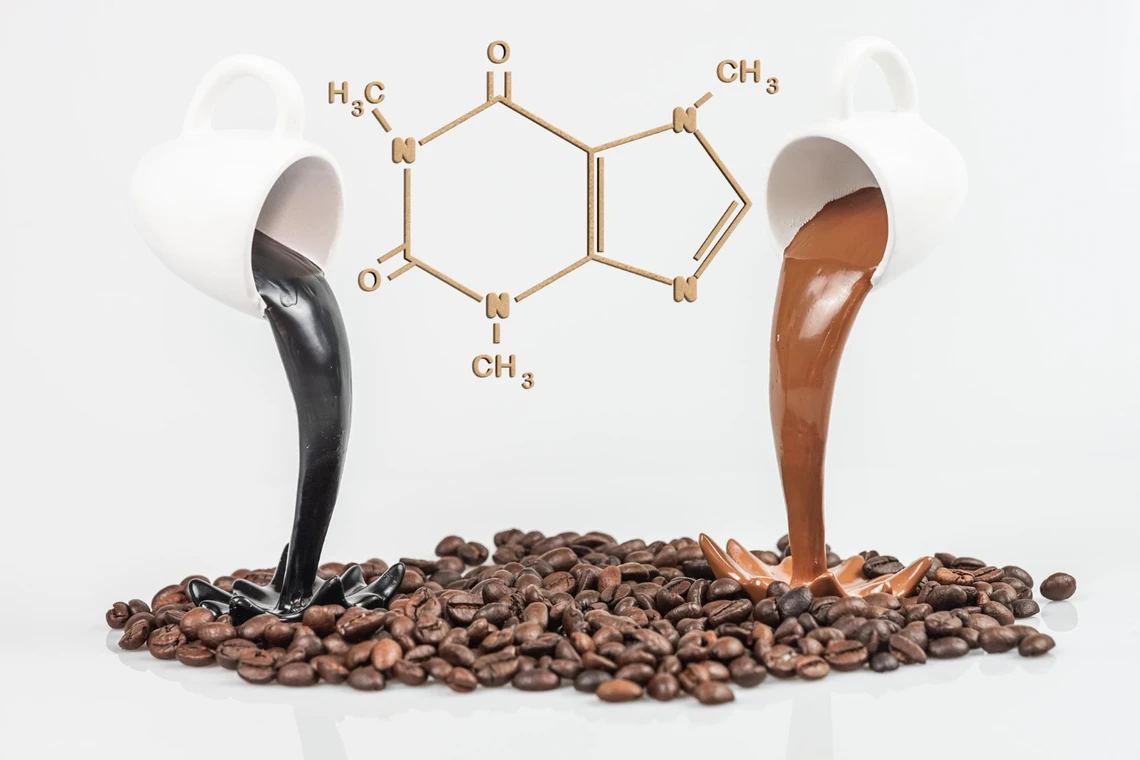
I will not write about the benefits and harms of caffeine, its effect on the body, the content of caffeine in other products, comparison with tea and chocolate. I suppose if you are interested in the amount of caffeine in coffee, you are already aware of all this. I will only talk about coffee drinks. Except that I will write that on the average for a healthy person a daily dose of 300-500 mg is considered safe, and about 200 mg per 1 kg of body weight (15000 mg for a person weighing 75 kg) taken within a few hours is a lethal dose.
It takes a lab with the proper equipment to measure the exact caffeine content, so I will rely on research from other people and organizations, as well as data from the beverage manufacturers themselves, which I consider to be the most reliable source.
How much caffeine is in a cup of coffee?
Specifically to such a question, there can be no adequate answer at all. It is necessary to specify which cup of coffee we are talking about, first of all, how the coffee was prepared and how much of it, coffee, is in the cup in milliliters or grams. There are other factors, but these are the main ones.
It follows that you can not say, for example, such things as “espresso has the most caffeine, so it is safer to drink Americano or filter coffee” – it is a complete nonsense. In this particular example, a classic Americano has exactly the same amount of caffeine (because it is the same portion of espresso diluted with hot water), and on average, one serving of filter coffee has more caffeine than one serving of espresso. You have to compare specific servings of specific coffee drinks.
For those who don’t want to read the whole article, here is the table
| McDonalds | Starbucks | Arabica | Robusta | Nespresso capsules | Decaffeinated coffee (decaf) | |
| Turka 200 ml | — | — | 130-170 mg | 260-340 mg | — | 2-3 mg |
| Espresso 30-40 ml | 71 mg | 75 mg | 40-60 mg | 80-120 mg | 50-100 mg | 1 mg |
| Double espresso 60 ml | 142 mg | 150 mg | 80-120 mg | 160-240 mg | — | 2 mg |
| Americano 240 ml/360 ml | 71/142 mg | 75/150 mg | 40-120 mg depending on whether on single or double espresso | 80-240 mg depending on whether on single or double espresso | — | 1-2 mg |
| Cappuccino 240 ml/480 ml | 71/142 mg | 75/150 mg | 40-120 mg depending on whether on single or double espresso | 80-240 mg depending on whether on single or double espresso | 50-100 mg | 1-2 mg |
| Latte 360 ml/480 ml | 71/142 mg | 75/150 mg | 40-120 mg depending on whether on single or double espresso | 80-240 mg depending on whether on single or double espresso | 50-100 mg | 1-2 mg |
| Filter coffee (for those who don’t realize, it’s just “coffee”) 360ml/480ml | 109/145 mg | 235/310 mg | 100-200 mg depending on volume (linear dependence), grains and spillage method | 200-400 mg depending on volume (linear dependence), grains and spillage method | — | 2-3 mg |
| Aeropress 180 ml | — | — | 80-120 mg | 150-200 mg | — | 1-2 mg |
| French press 200 ml | — | — | 120-150 mg | 240-300 mg | — | 2-3 mg |
Data from McDonalds, Starbucks, Nespresso and Nescafe are from the manufacturers themselves for the US market. But as a reference point this table is very indicative, plus/minus such average values in drinks by type and similar volumes will be in other countries, as well as in other manufacturers/coffee shops. The data for Nespresso capsules is for Nespresso Original (regular capsules), the new Nespresso Vertuo has a higher caffeine content.
About caffeine in espresso and espresso-based drinks
Double espresso is usually made from about double the amount of ground coffee (espresso preparation methods). That’s to put it crudely. In most modern coffee shops, the typical amount of ground coffee for single and double espresso is 10/18 grams, but there are, for example, 12/20 grams.
Americano, cappuccino, latte are made in normal coffee shops from single espresso. Establishments like McDuck use double espresso for large portions (300+ ml). Flat White, Long Black are always made with double espresso. Neither water nor milk has any effect on the caffeine content of the finished drink, i.e. the cup.
These are the general principles for all of these drinks, whether it’s McDuck’s, Starbucks, or the “takeaway coffee” stand at the bus stop. Or you brew at home in an automatic Delonghi – all milk and Americano, except for some tricky special programs, are made from regular espresso and there is the same amount of caffeine.
Example of a special program: Jura’s Flat White uses a double load of ground coffee, which at maximum strength will be 2×16=32 grams.
About caffeine in filter coffee and alternatives
Notice in the table that a single serving of filter coffee contains significantly more caffeine than a single serving of espresso? The exact amount can vary greatly depending on the type of coffee and brewing settings, but the pattern remains the same. And by filter coffee is equally understood funnel/pourover/drip coffee maker/kemex/chario – the principle of preparation is the same, hence the values per unit volume are about the same.
About the caffeine in the turbo/jezve.
I haven’t found any reliable source with a measurement of caffeine in a serving of oriental-style coffee. But from general considerations about extraction and the physics of the process, there should be slightly more in a single 100 ml serving than in a single 30 ml espresso. Accordingly, 200 ml of Turkish-style coffee contains a double dose of caffeine, and it’s more than that of a double espresso. In terms of exactly per serving, not liters or milliliters, it is the most caffeine-containing beverage.
About the caffeine in instant coffee
There is almost no natural caffeine in instant coffee. It is seriously destroyed by soaking and heating, the final drying of the concentrate from the original ground beans from which the instant is made. Yes, instant coffee is still made from real coffee beans. All instant coffee manufacturers add synthetic caffeine (made from uric acid and xanthine) to the product to some degree. How much of it they add, little, a lot, is up to them. Again, in some countries manufacturers are obliged to write the caffeine content on the packaging.
For example – instant Nescafe Classic contains 98 mg and 130 mg of caffeine per cup in 360 and 480 ml, respectively (official data from Nestlé). On average, two teaspoons of regular instant coffee has about as much caffeine as a double espresso, one teaspoon has 30-50 mg depending on the manufacturer. Despite the fact that some of it is synthetic, this does not change the essence, the main thing is the amount.
Comparison of beverages by absolute amount of caffeine per serving

Bottom line, if we use the same beans (let it be typical Brazil Santos) and more or less classic preparation recipes and final volumes, then in terms of 1 serving of the drink, the absolute amount of caffeine in them will be in an ascending order:
What does the caffeine content of the same brewing method depend on, how to reduce?
Yes, why are there such large forks of values in the table, sometimes one and a half or even two times? How to brew closer to the lower limit? P.S.: tedious theory.
The caffeine content of a cup is basically dependent on five factors:
- The initial amount of caffeine in the original bean.
- The number of beans (in grams, but total in pieces) used to make the beverage.
- The degree of extraction of chemical elements from the beans into the beverage. Extraction = extraction.
- The time of preparation, more specifically the contact of the coffee with water, which affects the percentage of caffeine that will have time to transfer from the beans to the beverage, plus it comes out unevenly throughout the process.
- The amount of water in contact with the coffee.
1. Beans
Robusta has about twice as much caffeine as Arabica. The taller the coffee tree grew, the less caffeine is likely to be in its beans. This is not a 100% rule, but it usually is. Washed processed beans usually have less caffeine than natural or experimental processed beans (see the profile piece on coffee for the coffee machine for more information on processing). When making the same beverage from different beans, the more sour the result tastes, the less caffeine is likely to be present.
Bottom line, the first principle for reducing caffeine in your cup is to use high altitude washed Arabica from countries like: Ethiopia, Kenya, Tanzania, Colombia. Counter-examples: robusta from Uganda, Vietnam, India.
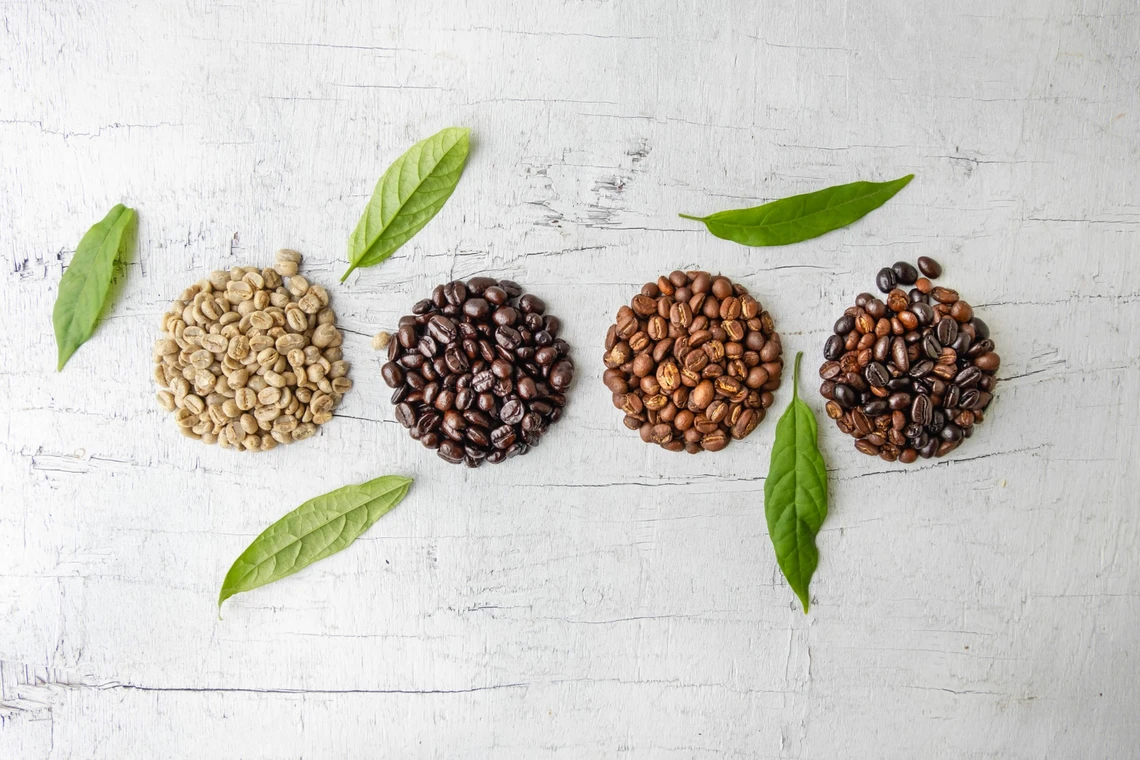
According to the latest data, roasting does not directly affect the caffeine content of each bean, it was as much in the original green, so much and remained at any roasting. But the more strongly roasted the grain, the more it loses in mass. And 10 grams of lightly roasted grain, if counted in pieces, will contain fewer grains than 10 grams of darkly roasted grain. And since each bean has the same amount of caffeine, that means 10 grams of lightly roasted beans will have less caffeine than 10 grams of darkly roasted beans.
The second principle for reducing caffeine in a cup when brewing “by weight” is to use light roasted coffee.
2. Amount of coffee
Obviously, the more beans involved in making the beverage, the more caffeine will be in the cup. Different drinks are made from different amounts of beans. But after all, the same type of drink can also be prepared from different masses, or rather quantities, of beans. Basically, a double espresso can be made from 15 grams, or it can be made from 20 grams. The difference in this case will be linear, in the second case there will be one third more caffeine. And the same works plus/minus for all drinks.
There are related nuances when, for example, you doubled the amount of coffee, but reduced the amount of water when making the French press, and the water just couldn’t/can’t take up twice as much caffeine because the extraction deteriorated.
3. Degree of extraction
Simply put, it is the extraction of substances from something, in this case coffee into a beverage. Extraction depends on a mass of factors. For example, the source water. Depending on its TDS (total dissolved solids), water can take more or less of the substances from coffee, including caffeine. If you’re cooking with water from a 100-year-old rusty water supply, it can take little of anything from the beans, including caffeine. Distillate, on the other hand, extracts everything. On a more tangible level, extraction is affected by the grind, pressure and temperature. The finer the grind and higher the rest, the higher the extraction.
That’s why the highest extraction per unit of time occurs in espresso brewing, both pressure and temperature. But both, depending on the equipment, can be adjusted. Temperature is adjustable even on home grain machines. Pressure is more difficult, but you can play with it on professional cone machines and, for example, on lever coffee makers.
Another question is what is more important to you: flavor or caffeine content? I believe that the flavor is. So purposely underestimating the amount of coffee used, temperature and pressure to reduce the milligrams of caffeine, but drinking an under-extracted medicinal-grassy brew is not a good idea.
Regarding the grind. Contrary to the obvious customizability, adjusting it for the sake of caffeine reduction isn’t really going to work. Because for almost every method of preparation there is not a very large fork of acceptable grind. The best illustration is espresso on single-bottom baskets. There, if the grind is slightly off, then the recipe is “off” at once, and you get some kind of booze. But this goes back to the question of what is more important to whom.
4. Time
This is an extraction-related parameter. The longer the coffee is in contact with water of any temperature, the more substances come from it into the beverage. Caffeine is no exception. This is why coffee from the turbo contains a lot of caffeine – the temperature is high, the brewing time is long, and the grind is minimal. In general, the faster the same type of drink is prepared, the less caffeine it contains. Plus for espresso, there are different versions, but the dominant one is this: caffeine is extracted in the last stages of preparation, so to interrupt the process a little earlier – get less caffeine in the cup. For filter coffee and other “long” methods of preparation the question of the order of extraction of substances is not so acute, there from the beans has time to extract everything approximately evenly.
5. The amount of water in contact with the coffee
It seems that this is directly related to the amount of the final drink in a portion? Not always. For example an Americano, you can pour 100 ml of water into a serving of espresso, or you can pour 400 ml, the final volume of the beverage in the cup will be many times different, but the amount of caffeine is the same. What matters is the volume of the water that came in contact with the coffee during the brewing process. Therefore, large lungos, voluminous turbos, filter coffees and similar drinks can contain a lot of caffeine. The lack of pressure during extraction is compensated for by the amount of water and the time of its contact with the coffee – it has time to take away all the caffeine that could have been there originally.

Summary on caffeine in coffee
- The smaller the initial coffee deposit, the amount of water in contact with it, the contact time, temperature and pressure, the coarser the grind, and the higher and more acidic the initial bean (and of course without Robusta impurities) – the less caffeine in the final drink.
- It may surprise many people, but the least caffeinated drink per serving is ristretto.
- The highest caffeine content is in large servings of turba and French press.
- There’s caffeine in instant coffee too, with each teaspoon having about the same amount as a single espresso.
If you have contraindications or concerns about caffeine – drink freshly roasted decaf, it can be quite acceptable and even tasty. In this case, a good strategy is to drink one serving of any “normal” coffee drink in the morning, and then sip on decaf – the typical caffeine content in a serving of any decaf drink is 1-3 mg.
Bonus track: caffeine in green coffee
Green coffee is beans that have not been heat-treated. According to recent studies, roasting the beans does not affect their caffeine content. That is, one green bean has the same amount of caffeine as one roasted bean. Since green beans are much heavier than roasted beans, there is less caffeine per mass in green beans. But the important thing is that this caffeine can only get into a beverage (brewed from green beans) by extraction – the extraction of substances from the grain into water.
Extraction for green beans is extremely small, it is simply negligible. That is why it is basically useless to drink an infusion of green coffee. If the green bean will be whole, then to extract at least something from it, it will need to be soaked for a day. If you buy already crushed green beans (grinding it on a regular coffee grinder will not work – too hard), then some traces of caffeine from it in the drink will come out, but it’s all from the evil one. For simplicity, you can consider that a drink made of green coffee has the same amount of caffeine as a decaf brew.
FAQ
Which coffee contains the least amount of caffeine
The least amount of caffeine is found in decaffeinated coffee (decaf), which is virtually caffeine-free, usually less than 3 mg per serving. This makes it an ideal choice for those who want to avoid caffeine completely.
Additionally, there are coffee varieties that are inherently low in caffeine, such as lowcaf. For example, the laurina variety has a caffeine content of 0.3% to 0.7%, which is much lower compared to traditional arabica, which has a caffeine content of around 1.4%.
Thus, if you are looking for a coffee with minimal caffeine content, opt for decaffeinated varieties or lowcaf.
Which method of making coffee retains more caffeine
The method of coffee preparation that retains more caffeine is Cold Brew. Studies show that caffeine extraction is significantly higher with this method. For example, cold brewing dark roast coffee can extract up to 1,000 mg of caffeine per liter, while medium roast coffee can extract up to 1,200 mg per liter.
Compared to hot methods such as espresso or filter coffee, where caffeine concentrations do not exceed 800 mg per liter, Cold Brew shows higher extraction efficiency.
It is also worth noting that dark roasting of the beans may result in higher caffeine content in the final beverage compared to light roasting, although the degree of roasting itself does not affect the caffeine content of the beans.
Which coffee is the best choice for those who are sensitive to caffeine
For people who are sensitive to caffeine, decaffeinated coffee is the best choice. It contains a very low amount of caffeine (usually less than 3 mg per serving), making it a safe option for those who want to avoid the stimulating effects of caffeine but still enjoy the taste and aroma of coffee.
Coffee recommendations for sensitive individuals:
– Decaffeinated coffee: This option is ideal for people with hypertension, heart rhythm disorders, or those who experience anxiety from regular coffee. Decaffe retains most of the flavors of regular coffee and can be consumed at any time of the day, even before bed.
– Arabica varieties: Coffee made from Arabica beans generally contains less caffeine compared to Robusta. Choosing mild, low roast Arabica varieties can also help reduce the overall amount of caffeine in your drink.
– Brewing methods: Avoid strong brewing methods such as espresso or Turkish coffee, which can contain more caffeine in a small volume. Instead, opt for filtered or Cold Brew coffee, which can be brewed with a lower concentration of caffeine.
Thus, decaffeinated coffee is the best choice for those who want to minimize their caffeine intake.
Which coffee is best to drink before going to bed
For those who want to drink coffee before bed, decaffeinated coffee is the best choice. It contains a minimal amount of caffeine (usually less than 3 mg per serving), allowing you to enjoy the taste of coffee without the risk of disrupting your sleep.
Recommendations for choosing coffee before bedtime:
– Decaffeinated coffee: This option retains most of the flavor of regular coffee but does not cause an awake effect, making it safe to consume before bed.
– Low-caffeine natural varieties: Choose Arabica varieties, which generally contain less caffeine compared to Robusta. This can help reduce the overall amount of caffeine in your drink.
– Strength of the drink: If you do prefer regular coffee, choose less strong options and try to drink it a few hours before bedtime to minimize the effects of caffeine on sleep quality.
It’s important to remember that individual sensitivity to caffeine can vary. If you notice that coffee is affecting your sleep, it’s best to avoid it 4-6 hours before bedtime.
Related Articles
How is decaffeinated coffee (decaf) made? Benefits, harms and differences
Let me clarify right away, instant decaffeinated coffee is not the subject of this article, because all instant coffee is…
Read moreDetails
Ristretto – what is that type of coffee you may have seen on the menu of a coffee machine or Italian cafe? Differences from espresso
Ristretto is an Italian coffee drink that is a shortened version of espresso. It is prepared similarly to espresso, but…
Read moreDetails