 Home
Home Recipes
 Beans
Beans Gear
Gear Roasting
 Brewing
 FAQ
FAQ

Definition
Excelsa coffee, now botanically reclassified as a variety of Coffea liberica rather than a distinct species, is characterized by its tart, fruity flavor profile, disease resistance, and distinctive almond-shaped beans that combine traits of both light and dark roasts in a single cup.
Description
Excelsa coffee was originally discovered in 1903 in the Lake Chad region of central Africa and was named for its “excellent” qualities by its discoverer, French botanist Auguste Chevalier. It was initially classified as its own species (Coffea excelsa) but has been reclassified in recent taxonomic studies as a variety of Coffea liberica, now properly called Coffea liberica var. dewevrei.
Excelsa trees are tall and robust, growing up to 13-14 meters (43-46 feet) in height, though not quite as tall as typical Liberica trees. They demonstrate excellent drought resistance and can thrive in poor soils where other coffee species might struggle. Excelsa grows well in low to middle elevations, typically from 400-1,200 meters (1,300-4,000 feet) above sea level, and is adapted to tropical climates similar to Liberica.
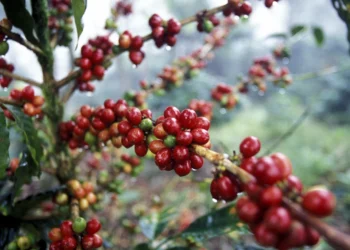
The leaves of Excelsa are large but generally smaller than those of Liberica proper. Its cherries are relatively small and round to oval-shaped, ripening from green to red. The beans themselves are distinctive, with an almond-like shape that’s less asymmetrical than typical Liberica beans but still larger than Arabica.
What truly sets Excelsa apart is its unusual flavor profile, which has been described as having characteristics of both light and dark roasts simultaneously. It exhibits a tart, fruity acidity reminiscent of light roasts, while simultaneously delivering deeper, darker notes associated with dark roasts. Tasting notes often include unusual combinations like dark fruits, woody undertones, cereal-like flavors, and sometimes spicy or herbal qualities. The complexity makes it valued as a blending component to add interesting dimensions to coffee blends.
Commercially, Excelsa remains a minor player, accounting for less than 1% of global coffee production. It is primarily grown in Southeast Asia, particularly in Vietnam, the Philippines, and Indonesia, as well as in parts of Africa. Its production is often localized, with much of the harvest consumed domestically rather than exported.
Due to its scarcity in global markets, Excelsa is rarely found as a single-origin offering. However, some specialty roasters occasionally feature limited releases, and it’s sometimes used in regional coffee blends to add complexity and uniqueness. In the Philippines, some local producers market Excelsa alongside Liberica as part of traditional coffee offerings.
See also
- Liberica Coffee (Coffea liberica)
- Coffee Taxonomy
- Coffee Genetic Diversity
- Rare Coffee Varieties
- Coffee Breeding Programs
- Southeast Asian Coffee Production
FAQ
Is Excelsa the same as Liberica coffee?
While Excelsa was previously classified as its own species (Coffea excelsa), botanical research has reclassified it as a variety of Liberica, now known as Coffea liberica var. dewevrei. Despite this taxonomic revision, Excelsa remains distinct in both physical characteristics and flavor profile. The beans are typically smaller and more regular than classic Liberica, and the flavor profile is notably different, with more tart, fruity notes and a complex taste that combines characteristics of both light and dark roasts.
Why is Excelsa coffee so hard to find?
Excelsa is difficult to find for several reasons: it represents a tiny fraction (less than 1%) of global coffee production; much of what is produced is consumed locally in growing regions rather than exported; its tall stature makes harvesting labor-intensive; and market demand remains limited due to low awareness. Additionally, as it’s often classified as a variety of Liberica rather than its own species, it may sometimes be marketed simply as “Liberica” without the distinction being made clear.
What makes Excelsa’s flavor profile unique?
Excelsa’s most distinguishing characteristic is its ability to simultaneously express flavor notes typically associated with both light and dark roasts. It often displays bright, tart fruitiness alongside deeper, darker tones in the same cup. This unusual combination makes it particularly valuable as a blending component, where it can add complexity and unique dimensions. The flavor has been described as having wild berry notes, cereal-like qualities, woody undertones, and sometimes spicy characteristics, creating a taste experience distinct from the major commercial species.
Does Excelsa have potential for the future of coffee production?
Yes, Excelsa holds significant potential for the future of coffee, particularly as the industry faces challenges from climate change and coffee leaf rust disease. Its natural drought tolerance, disease resistance, and ability to thrive in warmer conditions at lower elevations make it valuable for breeding programs developing climate-resilient coffee varieties. Additionally, as consumers increasingly seek unique flavor experiences, Excelsa’s distinctive profile could find growing appreciation in specialty markets, especially as sustainable and diverse coffee production becomes more important.