 Home
Home Recipes
 Beans
Beans Gear
Gear Roasting
 Brewing
 FAQ
FAQ
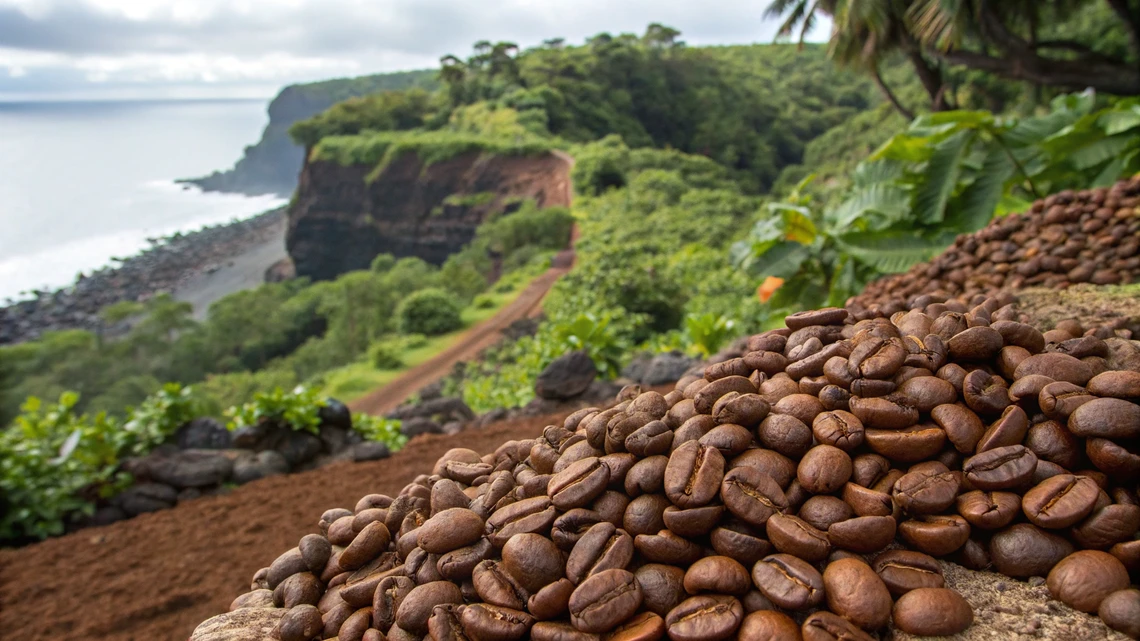
Hawaiian Kona represents America’s only internationally recognized premium coffee, grown exclusively on volcanic slopes of Hawaii’s Big Island where unique microclimates, rich soil, and meticulous cultivation create exceptionally smooth, balanced cups. Limited to roughly 2,600 acres along the Kona Coast, this Arabica coffee commands premium prices ($40-80+/lb) due to tiny production volumes, high American labor costs, and Protected Geographical Indication status. Known for mild acidity, full body, and clean chocolate-nut flavors without harsh edges, Kona delivers refined quality—but buyer beware: most “Kona blend” coffee contains only 10% actual Kona, making authentic 100% Kona both rare and expensive.
The Kona Coffee Belt: Perfect Geography
Kona coffee grows in a remarkably narrow zone on the western slopes of Hualalai and Mauna Loa volcanoes:
Geographic specifications:
The Kona Coffee Belt:
- Location: West coast of Hawaii’s Big Island
- Length: Approximately 20 miles north-south
- Width: Less than 2 miles wide
- Elevation: 500-3,000 feet (150-900 meters)
- Total area: Only 2,600 acres certified for Kona coffee
Districts within Kona belt:
- North Kona – Higher elevations, brighter acidity
- South Kona – Lower elevations, fuller body
- Holualoa – Premium area, complex profiles
- Honaunau – Traditional farms, balanced cups
Why this specific area?
Climate advantages:
- Morning sun – Bright sunshine for photosynthesis
- Afternoon clouds – Natural shade from volcanic clouds
- Rainfall – 40+ inches annually, evenly distributed
- Temperature – 70-75°F year-round, minimal variation
- No frost – Tropical consistency
Volcanic soil benefits:
- Mineral-rich – Lava-based, exceptional nutrients
- Well-draining – Porous volcanic rock prevents waterlogging
- pH ideal – Natural acidity perfect for coffee
- Depth – Deep topsoil from centuries of decomposition
This unique combination—volcanic soil, perfect elevation, morning sun, afternoon shade—exists nowhere else in the United States, making Kona impossible to replicate.
Hawaii’s Grading System: Extra Fancy to Prime
Hawaii uses a bean-size and defect-based grading system, more rigorous than most origins:
| Grade | Screen Size | Defect Standards | Quality Level |
|---|---|---|---|
| Extra Fancy | 19+ (largest) | <10 defects per 300g | Highest, most expensive |
| Fancy | 18 | <16 defects per 300g | Premium quality |
| Number 1 (Kona #1) | 16-17 | <18 defects per 300g | Good specialty |
| Select | Variable | Slightly more defects | Commercial specialty |
| Prime | Smaller beans | Higher defects | Lower commercial |
| Peaberry | Round beans | Special sorting | Specialty, premium priced |
Extra Fancy specifications:
- Largest beans (screen size 19+)
- Maximum 10 defects per 300 grams
- Visual perfection required
- Commands highest prices ($50-100+/lb)
- Limited availability
Kona Peaberry (special grade):
- Single round bean instead of two flat beans
- Occurs in 3-5% of cherries
- Separate sorting and processing
- Often more expensive than Extra Fancy
- Concentrated flavor (some claim)
Important note: Higher grades don’t necessarily mean better flavor—Extra Fancy has larger, prettier beans, but Fancy or #1 from quality farms often cup equally well at lower prices.
Flavor Profile: Smooth and Balanced
Hawaiian Kona delivers a distinctly mild, refined Central American-style profile:
Common tasting notes:
- Nuts – Macadamia, almond, hazelnut (signature)
- Chocolate – Milk chocolate, cocoa, subtle sweetness
- Brown sugar – Caramel, light toffee
- Citrus – Very subtle orange, lemon (never sharp)
- Butter – Creamy, smooth texture
- Vanilla – Light, sweet undertones
- Floral hints – Delicate, not dominant
Key characteristics:
- Acidity: Low to medium – smooth, never aggressive
- Body: Medium to full – creamy, buttery mouthfeel
- Sweetness: Moderate, brown sugar and chocolate
- Balance: Exceptional smoothness, no rough edges
- Complexity: Subtle layers, refined rather than explosive
- Finish: Clean, sweet, gentle
What defines Kona: The signature is smoothness and lack of harshness—no sharp acidity like Costa Rica Tarrazu, no intensity like Kenya AA, no explosive florals like Ethiopian coffees. Kona is coffee for those who want refined quality without challenging flavors.
“Hawaiian Kona is what I describe as ‘luxuriously boring’—and I mean that as a compliment. It’s so smooth and balanced that there’s nothing to criticize, but also nothing that jumps out and grabs you. It’s like a perfectly executed classical piece: technically flawless, beautifully presented, but not adventurous. At $60/lb, you’re paying for consistency, smoothness, and the story of American-grown coffee on volcanic slopes.”
— Alex Thompson
The Kona Blend Fraud Problem
CRITICAL CONSUMER WARNING:
Most coffee labeled “Kona” or “Kona Blend” contains very little actual Kona coffee:
Legal loopholes:
- “Kona Blend” – Only requires 10% Kona by law
- 90% can be cheap beans from anywhere
- No requirement to state percentage on front label
- Retail prices – Often $15-25/lb (impossible for real Kona)
How to identify authentic Kona:
- Must say “100% Kona Coffee” clearly on front
- Grade specified (Extra Fancy, Fancy, #1, Peaberry)
- Farm or estate name for traceability
- Hawaii Department of Agriculture seal
- Realistic pricing ($40-100+/lb retail)
Red flags for fake/blend Kona:
- “Kona Blend” without percentage
- Prices under $30/lb retail
- No grade designation
- Generic “Hawaiian coffee” claims
- Roaster unwilling to provide sourcing details
Bottom line: If it seems too cheap to be true, it’s probably 10% Kona and 90% something else. Genuine 100% Kona is expensive and clearly labeled.
Processing and Production
Kona coffee production follows traditional methods with modern quality control:
Washed Processing (95%+):
- Selective hand-picking – Only ripe cherries
- Depulping – Within 24 hours
- Fermentation – 12-24 hours in tanks
- Washing – Clean water channels
- Sun-drying – Hoshidana (Japanese-style drying decks) or patios
- Milling – Careful removal of parchment
Result: Clean, bright profile with maximum clarity and smoothness
Natural processing (rare):
- Experimental, very limited
- Some farms creating fruit-forward lots
- Still maintains Kona smoothness
Labor-intensive cultivation:
- Hand-picking required on steep slopes
- Multiple selective harvests
- Small family farms (average 5-7 acres)
- High American labor costs ($15-20/hour vs. $2-5 in Central America)
This labor intensity is a primary reason Kona costs 3-5x more than comparable Central American coffees.
Best Brewing Methods
Kona’s smooth, balanced nature works across methods but shines in certain applications:
Pour-Over (V60, Chemex, Kalita):
- Highlights clarity and subtle complexity
- Medium grind, 200-205°F
- Ratio 1:16
- Result: Clean, nuanced, showcases Kona’s refinement
Drip Coffee Maker:
- Excellent everyday choice
- Kona’s smoothness perfect for automatic brewing
- Result: Consistent, pleasant daily coffee
French Press:
- Develops fuller body and creaminess
- Medium-coarse grind, 4 minutes
- Result: Rich, buttery, smooth
Cold Brew:
- Brings out natural sweetness
- Incredibly smooth, no bitterness
- 18-24 hour steep
- Result: Silky, sweet, chocolate-nut profile
Espresso (less common but works):
- Mild, sweet shots
- Good in milk-based drinks
- Lacks intensity for straight espresso lovers
- Result: Smooth, inoffensive shots
Kona’s smoothness means it’s nearly impossible to brew poorly—forgiving for all skill levels.
Roast Level Recommendations
Kona’s mild profile works across roast spectrum but has specific sweet spots:
Light roast:
- Preserves subtle complexity
- Citrus and floral notes emerge
- Good for pour-over enthusiasts
- Less common commercially
Light-medium roast:
- Balanced, developing sweetness
- Nut and chocolate notes
- Appeals to wide audience
Medium roast (MOST COMMON):
- Traditional Kona roast
- Maximizes smoothness and body
- Chocolate and nut dominant
- What most Kona roasters offer
- Perfect for drip and French press
Medium-dark roast:
- Still acceptable – Kona survives well
- Fuller body, minimal acidity
- Loses some origin character
- Popular in Hawaii tourism market
Dark roast:
- Wastes Kona’s subtle qualities
- Becomes generic dark coffee
- No reason to pay premium prices
Most authentic Kona roasters use medium roast to showcase the origin’s natural smoothness without overwhelming delicate flavors.
Pricing Reality: Why So Expensive?
Understanding Kona’s high cost requires looking at production economics:
Cost factors:
- Limited land – Only 2,600 acres total
- American labor – $15-20/hour vs. $2-5 globally
- Small farms – No economies of scale
- Hand processing – Labor-intensive selective picking
- High land values – Hawaii real estate premium
- Shipping – Transport to mainland adds cost
- Certification/regulation – State oversight and verification
Price breakdown:
- 100% Kona Extra Fancy: $60-100/lb retail
- 100% Kona Fancy: $50-80/lb retail
- 100% Kona #1: $40-65/lb retail
- 100% Kona Peaberry: $70-110/lb retail
Comparison:
- Similar quality from Guatemala or Costa Rica: $18-30/lb
- Kona premium: 2-4x higher for comparable cup quality
Is it worth it?
- For the story/experience: Yes—American-grown, unique terroir
- For pure cup quality: Debatable—many $25/lb coffees cup equally well
- For rarity/collectability: Yes—limited production
- For daily drinking: Probably not—better values exist
Hawaiian Kona vs. Other Premium Origins
How does Kona compare to other high-end coffees?
| Characteristic | Hawaiian Kona | Jamaica Blue Mountain | Panama Geisha | Guatemala Antigua |
|---|---|---|---|---|
| Acidity | Low-medium | Low | Very high | Medium-high |
| Body | Medium-full | Medium-full | Light | Full |
| Primary notes | Nuts, chocolate | Mild, balanced | Jasmine, tropical fruit | Chocolate, spice |
| Complexity | Subtle | Subtle | Extreme | High |
| Price | $40-100/lb | $50-150/lb | $40-1,000+/lb | $16-32/lb |
| Production | Very limited | Very limited | Limited | Moderate |
Kona’s position:
- Similar style to Jamaica Blue Mountain (mild, smooth, expensive)
- More approachable than extreme origins
- Premium pricing based on rarity and American origin
- Cup quality comparable to good Central American SHG at 3x the price
Who Should Buy Hawaiian Kona
Kona is ideal for:
- Coffee collectors seeking rare American origin
- Those who value story and terroir over pure value
- Smooth coffee lovers who dislike acidity
- Gift purchases (impressive origin story)
- Special occasion coffee
- Supporting American agriculture
Better alternatives if:
- Budget-conscious: Nicaragua SHB, Honduras SHG offer similar smoothness at $14-20/lb
- Seeking complexity: Ethiopian Yirgacheffe, Panama Geisha more interesting at similar/lower prices
- Daily drinking: Many $18-25/lb origins deliver comparable enjoyment
Buying advice:
- Only buy labeled “100% Kona Coffee”
- Verify grade and farm/estate
- Expect to pay $40+/lb retail
- Try small sample before committing to full pound
- Consider Fancy or #1 instead of Extra Fancy (better value, similar quality)
The Future of Kona Coffee
Challenges ahead:
- Climate change – Shifting rainfall patterns
- Labor shortage – Aging farmer population
- High costs – Increasing land and labor expenses
- Competition – Other Hawaiian islands developing coffee
- Fraud – Ongoing blend labeling issues
Opportunities:
- Premium positioning – Rarity supports pricing
- Tourism synergy – Direct farm sales
- Quality focus – Moving upmarket vs. volume
- Specialty processing – Experimental lots
- Direct-to-consumer – Bypassing middlemen
Hawaiian Kona represents coffee as luxury product rather than agricultural commodity—you’re paying for American labor, limited supply, perfect terroir, and the romance of island-grown coffee. The cup quality is genuinely good: smooth, balanced, pleasant, with no rough edges. But at 3-4x the price of comparable Central American coffees, Kona is ultimately about the experience and story as much as flavor. For those who appreciate what it represents, Kona delivers refined, consistent quality. For pure value seekers, better options exist. Either way, insist on authentic 100% Kona—anything less is paying premium prices for mostly generic coffee.
Related Articles

Honduras SHG Coffee
Honduras SHG (Strictly High Grown) represents Central America’s best-kept secret in specialty coffee—high-altitude beans offering exceptional quality at more accessible…
Read moreDetails
El Salvador SHG Coffee
El Salvador SHG (Strictly High Grown) represents Central America’s boutique specialty coffee origin—a small country producing limited volumes but exceptional…
Read moreDetails
Nicaragua SHB Coffee
Nicaragua SHB (Strictly Hard Bean) represents Central America’s exceptional value proposition in specialty coffee—high-altitude beans delivering balanced, approachable quality at…
Read moreDetails


