 Home
Home Recipes
 Beans
Beans Gear
Gear Roasting
 Brewing
 FAQ
FAQ

Definition
Coffea liberica is a distinct coffee species native to western and central Africa, characterized by its unusually large beans, asymmetrical shape, and unique flavor profile that combines floral, fruity, and woody notes.
Description
Liberica coffee originated in Liberia, West Africa (hence its name), and was first botanically classified in the late 19th century. It gained commercial significance in the 1890s when coffee leaf rust decimated Arabica plantations in Southeast Asia, particularly in the Philippines, where it was introduced as a rust-resistant alternative.
Liberica trees are notably large, growing up to 15-18 meters (50-60 feet) in height when unpruned, significantly taller than both Arabica and Robusta species. The trees produce distinctively large, leathery leaves that can reach lengths of 30 cm (12 inches). Liberica is adapted to lowland tropical environments and can thrive in hot, humid conditions at altitudes from sea level to about 600 meters (2,000 feet).
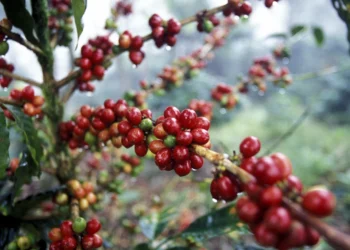
The most striking characteristic of Liberica is its unusually large, asymmetrical beans that have a distinctive “hook” at one end. The cherries are also larger than those of other coffee species, with a more irregular shape. These cherries typically transition from green to a deep red or purple when ripe.
The flavor profile of Liberica is distinctive and polarizing. It offers a complex combination of floral and fruity notes often accompanied by woody, smoky, and sometimes medicinal undertones. Many describe a characteristic “wild” taste that can include hints of tropical fruits, berries, and dark chocolate, with a full body and relatively low acidity. The aroma is often described as strong and somewhat reminiscent of jackfruit.
Commercially, Liberica accounts for less than 2% of global coffee production. It is primarily cultivated in Malaysia (particularly the Barisan region), the Philippines (where it’s locally known as “Kapeng Barako”), Indonesia, and to a lesser extent in some West African countries. In recent years, there has been renewed interest in Liberica as specialty coffee consumers seek novel taste experiences and as climate change threatens traditional growing regions for Arabica.
Notable examples include Malaysia’s “Peninsular Coffee” brand featuring Liberica, Len’s Coffee’s “Kapeng Barako,” and limited edition offerings from specialty roasters like Aroma Coffee and Old Town White Coffee’s premium Liberica line.
See also
- Excelsa Coffee (formerly classified as a Liberica variety)
- Kapeng Barako (Filipino coffee culture)
- Malaysian Coffee
- Coffee Species Diversity
- Climate Resilient Coffee
- Rare Coffee Varieties
FAQ
Why is Liberica coffee so rare?
Liberica coffee remains rare for several reasons: it’s more challenging to cultivate commercially due to its height, which makes harvesting difficult; it has lower yields compared to Arabica and Robusta; processing requires specific techniques to highlight its best qualities; and market demand has historically been limited to specific regions where it’s traditionally consumed, particularly the Philippines and Malaysia. Additionally, the global coffee industry has been heavily optimized around Arabica and Robusta production, processing, and marketing.
Does Liberica coffee contain more caffeine than other coffee types?
Liberica contains moderate caffeine levels, typically falling between Arabica and Robusta. Its caffeine content is approximately 1.6-2.0% by weight, higher than Arabica (1.2-1.5%) but generally lower than Robusta (2.2-2.7%). However, due to the larger bean size, a single Liberica bean may contain more total caffeine than a single Arabica bean.
Is Liberica becoming more popular in the specialty coffee market?
Yes, there’s growing interest in Liberica within specialty coffee circles, driven by several factors: the search for distinctive flavor experiences; concerns about coffee genetic diversity and climate resilience; and increased visibility through competitions and specialty roaster offerings. Organizations like World Coffee Research have also highlighted Liberica’s potential importance in developing climate-resilient coffee varieties. However, it remains a niche product that coffee enthusiasts seek for its uniqueness rather than a mainstream coffee option.
How should Liberica coffee be brewed to highlight its best qualities?
Liberica benefits from brewing methods that emphasize its full body and distinctive flavors while moderating its sometimes woody notes. Many experts recommend medium-dark roasts and full-immersion brewing methods like French press or traditional filtered coffee approaches like the Vietnamese phin. The larger bean size and density mean that Liberica may require different grind adjustments and potentially longer extraction times than Arabica. Experimenting with water temperature and brew ratios can help balance its unique flavor characteristics.