 Home
Home Recipes
 Beans
Beans Gear
Gear Roasting
 Brewing
 FAQ
FAQ

If there’s one coffee-gear decision that actually changes what’s in your cup, it’s the grinder — not the brewer, not the beans, the grinder. Two machines that look almost identical on a shelf can produce wildly different results depending on how they cut, crush, or shear the bean. Before you compare brands or price tags, it helps to understand the handful of design choices that separate one type of coffee grinder from another: how it grinds, how it’s powered, how finely you can adjust it, and how it doses the ground coffee out. This guide walks through each of those choices so you know exactly what you’re buying — and why it matters for your morning cup.
Burr Grinders vs. Blade Grinders: The Core Difference
Every grinder falls into one of two camps based on its cutting mechanism, and this is the single most important spec on the list.
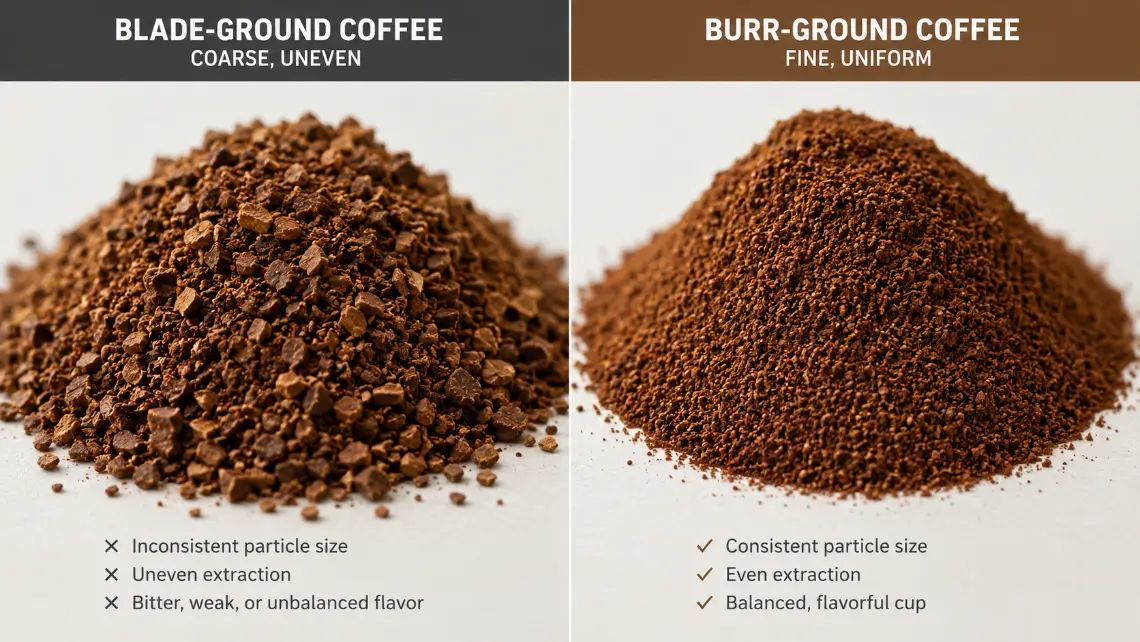
A burr grinder crushes beans between two abrasive surfaces — the burrs — set at a fixed, adjustable gap. Every particle that passes through comes out close to the same size, because the gap itself is what determines the grind, not how long you run the machine. That consistency is what makes extraction predictable, whether you’re pulling espresso or running a slow pour-over.
A blade grinder works more like a mini blender: a spinning blade chops beans into smaller and smaller pieces the longer it runs. There’s no fixed gap, so you get a mix of fine dust and coarse chunks in the same batch — what’s called an uneven or “shotgun” grind. That inconsistency translates directly into an inconsistent cup: the fines over-extract and turn bitter while the chunks under-extract and taste sour, often at the same time.
| Feature | Burr Grinder | Blade Grinder |
|---|---|---|
| Grind consistency | High — uniform particle size | Low — mixed fine/coarse particles |
| Heat generated | Minimal (especially at low RPM) | Higher, from prolonged blade contact |
| Adjustability | Precise, repeatable settings | None — only controlled by run time |
| Typical price range | $30–$3,000+ | $15–$40 |
| Best for | Espresso, pour-over, French press, drip | Casual, occasional use only |
Bottom line: if you care about flavor at all, a burr grinder is non-negotiable. Blade grinders are fine for spice grinding, but for coffee they cap how good your cup can ever taste, regardless of how good the beans or the brewer are.
Conical vs. Flat Burr Grinders
Once you’ve settled on a burr grinder, the burrs themselves come in two shapes.
Conical burrs are cone-shaped, with one burr nested inside the other. They spin at lower RPM, run cooler, and tend to be quieter — a common choice for home hand grinders and mid-range electric models.
Flat burrs are two ring-shaped discs facing each other. They spin faster, generate slightly more heat, and are prized in specialty and commercial settings for extremely even, repeatable particle distribution — especially at fine, espresso-level settings.
Neither shape is objectively “better” — conical burrs are generally more forgiving and quieter for daily home brewing, while flat burrs are the standard in high-end espresso setups where particle uniformity at very fine grinds is the priority.
Manual vs. Electric Grinders
This is a question of effort versus convenience, not quality — both types can use the same burr designs internally.
A manual (hand) grinder is operated by turning a crank, grinding one dose at a time. Because there’s no motor, heat transfer to the coffee is essentially zero, and even budget hand grinders can use high-quality conical burrs that would cost far more in an electric model. The trade-off is time and physical effort — grinding enough for a large pot by hand is a workout.
An electric grinder does the work via a motor, which is faster and better suited to grinding larger volumes or multiple servings back-to-back. Quality varies enormously here: a $50 electric grinder often performs worse than a $50 hand grinder, since motors, gearing, and larger burr sets add real cost.
Home vs. Commercial Grinders
This distinction is about duty cycle and volume, not just size.
Home grinders are built for intermittent use — a few doses a day — with smaller motors, smaller hoppers, and price points generally under $500.
Commercial grinders are built to run continuously for hours at a café’s pace, with larger motors that resist overheating, bigger burr sets for faster throughput, and price points that routinely start where high-end home grinders top out. Using a home grinder at commercial volume burns out the motor; using a commercial grinder at home is usually overkill on both price and footprint.
Stepped vs. Stepless Adjustment
This refers to how finely you can dial in grind size — a spec that matters more than most buyers expect.
A stepped grinder moves between grind settings in fixed increments — click, click, click — via a numbered dial. It’s simple and repeatable (setting “12” is always setting “12”), but you’re limited to whatever gradations the manufacturer built in.
A stepless grinder adjusts on a continuous gradient with no fixed clicks, letting you fine-tune between what would otherwise be two stepped settings. This matters most for espresso, where the difference between a great shot and a sour or bitter one can come down to a fraction of a millimeter that a stepped dial simply can’t reach.
Doser, Doserless & Single-Dose Grinders
The last distinction is about what happens to the coffee after it’s ground, and it splits into three approaches.
A doser grinder grinds continuously into a chamber and dispenses fixed-volume doses via a lever — a design built for high-speed café workflows, less common in home setups today.
A doserless grinder grinds directly into a portafilter or container on demand, with no holding chamber. It’s the standard on most modern home and prosumer machines because it’s simpler to keep fresh and clean.
A single-dose grinder takes this further: you weigh out only the exact amount of beans you’re about to grind, with no bean hopper sitting full of beans between uses. This minimizes stale, oxidized coffee sitting inside the machine and has become popular for retaining maximum freshness — though it does mean weighing beans before every grind rather than just scooping from a hopper.
Quick Reference Table: All Grinder Types at a Glance
| Grinder Type | How It Works | Best For |
|---|---|---|
| Burr Grinder | Crushes beans between two fixed-gap burrs | Anyone who cares about flavor consistency |
| Blade Grinder | Chops beans with a spinning blade | Occasional, low-stakes use only |
| Conical Burr | Cone-shaped burrs, lower RPM, quieter | Home brewing, hand grinders |
| Flat Burr | Ring-shaped discs, higher RPM | Espresso, specialty-level precision |
| Manual/Hand Grinder | Crank-operated, no motor | Travel, minimal heat, budget precision |
| Electric Grinder | Motor-driven | Speed, larger volumes |
| Home Grinder | Built for intermittent daily use | Personal/household brewing |
| Commercial Grinder | Built for continuous high-volume use | Cafés, offices, high-traffic settings |
| Stepped Grinder | Fixed click settings | Repeatable, simple dial-in |
| Stepless Grinder | Continuous adjustment | Espresso, fine-tuning precision |
| Single Dose Grinder | No hopper; beans weighed per grind | Maximum freshness, minimal waste |
| Doser Grinder | Grinds into a chamber, dispenses fixed doses | High-speed café workflows |
| Doserless Grinder | Grinds on demand, no chamber | Most modern home/prosumer setups |
Which Type of Grinder Should You Buy?
For most home coffee drinkers, the decision tree is simpler than the list above suggests: start with a burr grinder — that’s the one non-negotiable. From there, choose conical burrs and a doserless design unless you’re specifically chasing espresso-level precision, in which case flat burrs and stepless adjustment earn their higher price tag. Go manual if you’re grinding for one or two cups and don’t mind the arm workout; go electric if you’re grinding for a household or want speed. Single-dose is worth the extra step only if bean freshness is a priority you’re actively optimizing for.
“The biggest upgrade most home brewers can make isn’t a new coffee maker — it’s replacing a blade grinder with even an inexpensive burr grinder. It’s the one change that affects every single cup, no matter what you brew it with.” — Alex Thompson
FAQ