 Home
Home Recipes
 Beans
Beans Gear
Gear Roasting
 Brewing
 FAQ
FAQ
Not by coffee machines alone, so to speak. After all, they’re simply expensive. Even portafilter coffee makers aren’t as affordable these days. What are some “proletarian” options? Coffee in a cezve or Turkish pot? Yes, that’s classic, but it’s quite a separate drink, and what if you want coffee without the grounds? Drip coffee? Many consider it too watery. And again, prices are rising… is there a cheaper option?
The Moka pot is the answer! What is it?
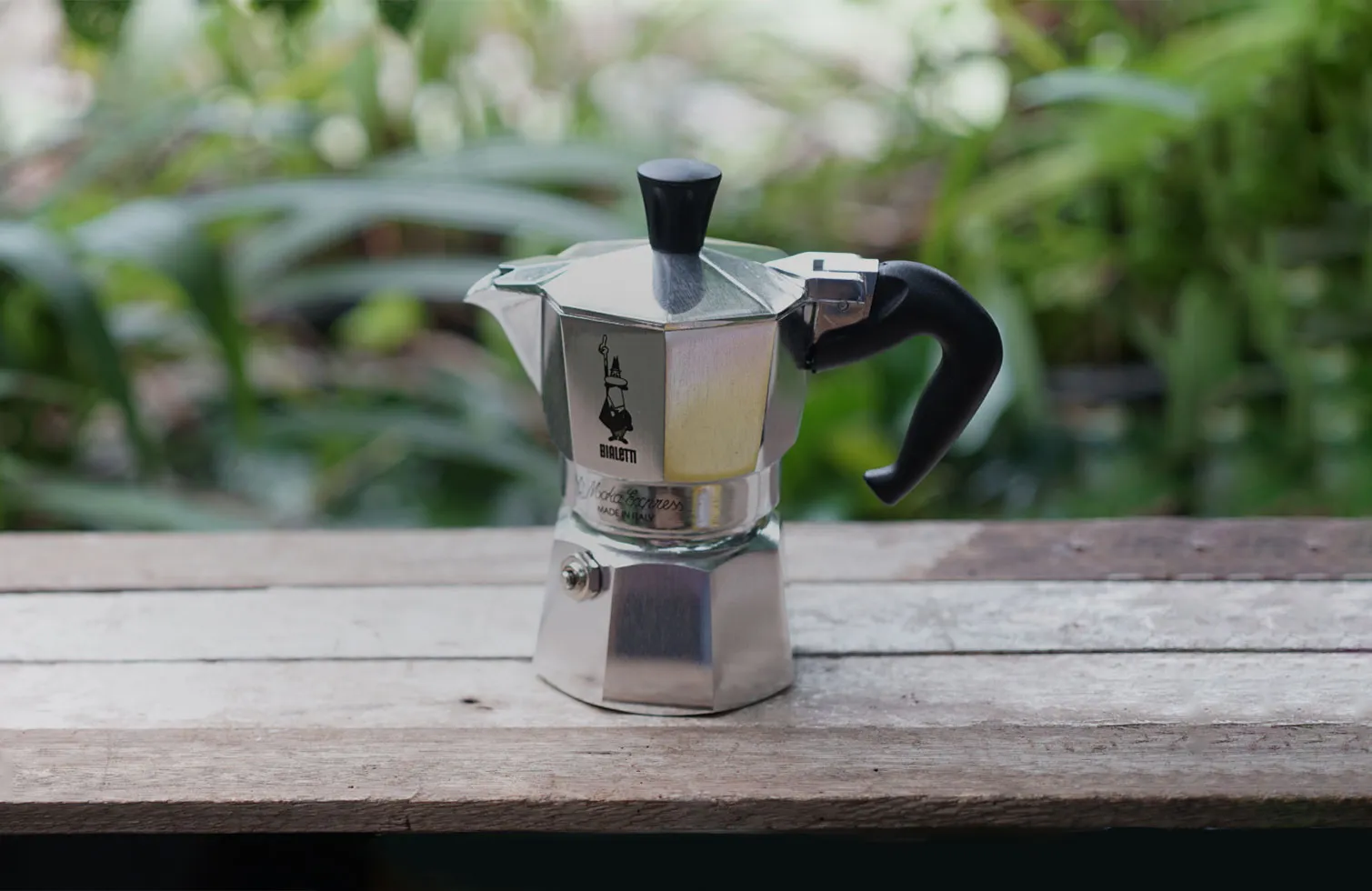
A Moka pot is a coffee maker where coffee is brewed with water that passes from bottom to top under steam pressure.
Where it all began
Moka pots have a rich history dating back to the 1930s. For many in post-Soviet countries, they’re familiar as thin aluminum models that have often seen better days.
Initially, the Moka pot coffee maker called “Moka Express” (yes, that’s right, express) was invented by an Italian, Alfonso Bialetti, in 1933. He also founded the company that now produces almost all Moka pots on the market, Bialetti. Actually, “Moka coffee maker” or even “Bialetti coffee maker” (the name has become generic) and Moka pot are synonyms.
The coffee maker initially had an octagonal, austere design and immediately gained incredible popularity in Europe, especially in Italy. It was, and still is, in every home and is one of the symbols of the country. It’s listed in the Guinness Book of Records as the most famous coffee pot in the world.
Enough theory, how does it work?
The operating principle of the Moka pot is based on steam pressure. The body consists of two parts that are tightly screwed together:
- Water is poured into the lower part, based on the capacity of the coffee pot. Each model is designed for a specific number of servings and works best when making exactly that number, calibrated to its shape. In any case, the water should not reach the emergency steam release valve. Use the mark inside as a guide (how to brew with a moka pot).
- Then insert the filter, into which coffee is poured. Fill the coffee to the top, even if you’re only going to drink one cup from a three-cup Moka pot. Obviously, it’s preferable to use freshly ground coffee rather than pre-packaged coffee from the store. It’s better to grind in a burr grinder. Grinding is acceptable in a wide range, except for the finest and coarsest degrees. The grind is how you adjust the strength of the coffee! If you use store-bought ground coffee, don’t take “Turkish grind”; you can take “espresso grind” or “filter grind” (again, you adjust the strength with the grind). Some manufacturers (for example, Lavazza) explicitly write on their coffee packages that it’s suitable for Moka pots (moka pot, or simply moka). It’s not necessary to tamp the coffee in the filter, but for a richer taste, it’s worth doing.
- Finally, screw on the upper part and place it on the heat. As the water boils in the lower part, it turns into steam, and the steam begins to push the remaining water upward. It passes through the coffee, absorbing aroma and flavor, and enters the upper container through the tube. Simple as can be.
Note that it’s water that passes through the coffee, not steam (which is why the filter tube extends almost to the bottom of the lower chamber). Steam only serves to “push out” the water. This is specifically designed to get the optimal temperature for espresso (which is what is made in Moka pots); if coffee were brewed with steam, it would be too hot for this beverage.
By the way, about the emergency valve. As the name suggests, it’s designed to “release” pressure if water cannot pass through the coffee tablet. This happens if you add too fine (“Turkish”) ground coffee to the brim and tamp it. In this case, the water will escape as steam through this emergency valve. In the past, it could get clogged with ground coffee and not work when needed. That’s why a couple of years ago, Bialetti upgraded the system, equipping the valve with a movable stick, which they recommend moving a couple of times a year during washing to clean possible contaminants.
Some usage tips
When making coffee in a Bialetti Moka pot, the main danger is burning or overheating the coffee. Therefore:
- If you use an electric stove, where it’s harder to monitor temperature than with gas, it’s advisable to choose the smallest burner and set a medium temperature (4-5 out of 10). If you want to heat it faster, you can initially set it to 7-8, but then switch to 4-5.
- Before the moment when coffee starts flowing into the upper chamber (after a couple of weeks of use, you’ll effortlessly learn to predict this moment), you can turn off the burner or even remove the coffee pot from it.
- At the very end of preparation, don’t wait until the Moka pot starts “snorting.” At this point, hot steam is already coming out, not hot water, which is bad for the coffee. If it does start snorting, you can run the lower part of the coffee pot under cold water from the tap, which will immediately stop the process.
- Some amount of water always remains in the lower chamber; this is normal.
- Coffee is usually not recommended to be tamped, but in fact, you can do it if you want a richer taste. Just don’t tamp too hard; you can press it down with a spoon. And make sure, of course, that the water is below the emergency valve!
- For those who are upset by the long coffee brewing process in the morning, you can advise assembling the coffee pot in the evening.
What about maintenance, does it take a lot of time?
Maintenance is primitive – wash all components after each preparation under running water. Don’t use chemicals or abrasive materials. Regarding the dishwasher – check the instructions for your specific Moka pot, as materials differ. For example, classic Moka Express pots can be washed, but they lose their shine after the dishwasher and become matte.
James Hoffmann, world coffee brewing champion and author of “The World Atlas of Coffee”: “The Moka pot holds a special place between espresso and filter coffee. It doesn’t replace either, but creates its unique flavor profile. I recommend using medium roast coffee and a slightly coarser grind than for espresso. And most importantly – remove the coffee pot from the heat as soon as the coffee starts rising to avoid overheating and bitterness.”
The latter especially applies to aluminum bodies, to avoid scraping off the top layer and adding a metallic taste to the coffee. In general, don’t try to clean the inner surfaces to a shine; the coffee oil residue actually protects the drink from interacting with the body.
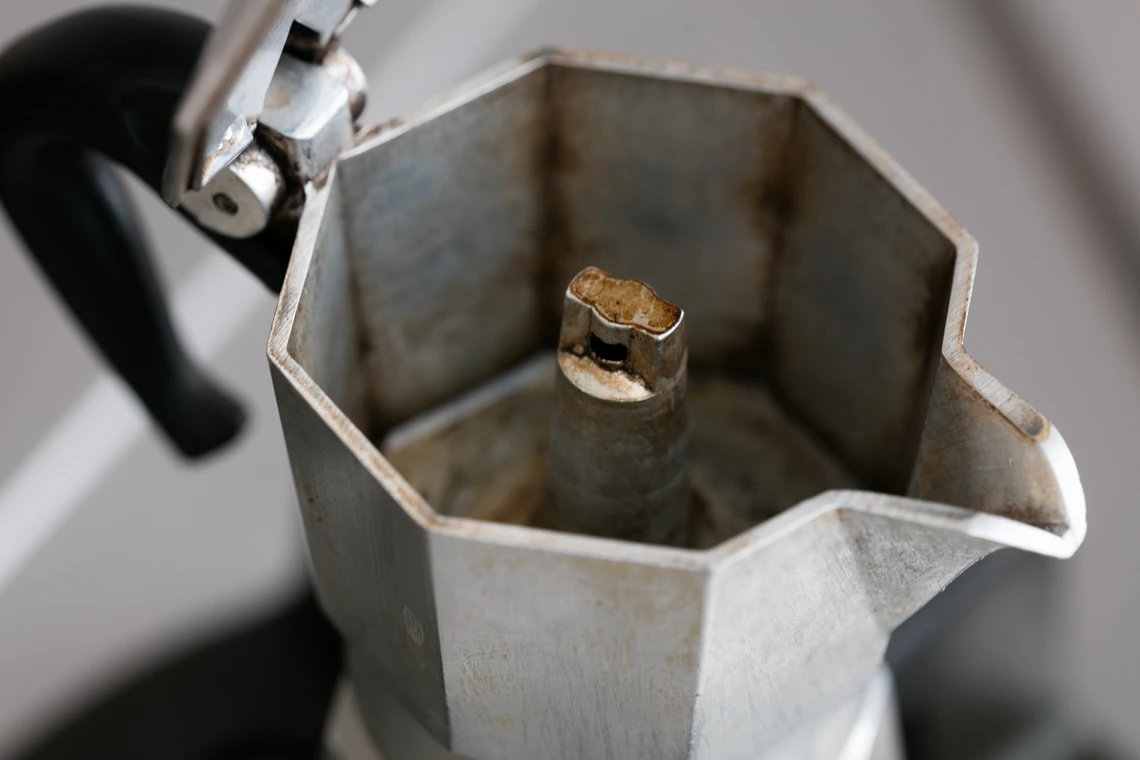
The only nuance is the rubber gasket for the filter; it wears out over time and starts siphoning steam, which may require replacement. Recommendation for extending its life – carefully clean it without applying force or using chemicals. As a last resort, after a couple of years, buy a repair kit for $5-10, consisting of a new filter-sieve and sealing rubbers. And your Bialetti will be like new.
So in fact, maintenance is extremely simple; this is one of the strong points of the Moka pot.
What are the options?
The Bialetti Moka Express from 1933 is still produced today; it’s a classic Moka pot for electric or gas stoves. It can even be used on a campfire or, for example, at a dacha (country house).
Michel Vilasis, a barista and trainer from New York: “Many underestimate Moka pots, considering them a ‘budget’ alternative. But when used correctly, they give amazing results. My secret is to preheat the water almost to boiling before pouring it into the lower chamber. This reduces brewing time and prevents coffee overheating.”
Different Bialetti Moka models essentially differ in three things:
- Volume – from 1.5 oz (40 ml) to almost 34 oz (1 liter).
- Material – aluminum (like the original design), stainless steel. Plus you can find modern versions with ceramic or glass upper parts.
- Design.
The final product is the same everywhere and doesn’t depend on the specific model. The influence of the original coffee (variety, freshness, grind) is an order of magnitude higher. So you can choose based on appearance and budget.
A Moka pot is far from “rocket science,” so quality Moka pots are produced not only by Bialetti but also by many companies from around the world. Such alternatives are made both in classic bodies and experimenting with form. I’ll name a few brands as examples: Alessi Pulcina (very original design), Bodum (the Swiss company is famous primarily for French presses, but also makes good steel Moka pots), Grosche, GSI Outdoor, De’Longhi, Primula, IKEA (yes, they also make simple and affordable models), Cuisinox, and many others. I can’t definitively describe which brands are “good” and which are “bad.” The main thing is to pay attention to the quality of materials, the absence of foreign odors, and good fit of parts to each other.
Where are they made?
Original Bialetti’s are now produced in both Europe and Asia: there are factories in their native Italy, Romania, Turkey, India, and China.

As far as I know, the classic Bialetti Moka Express series (from $25-30) is still Italian-made, but the painted (colored) “express” models are from Romania. The Brikka and Fiammetta series (from $25) are also assembled there. The most affordable of the original Bialetti Junior (from $20) is made in China, as are the Bialetti Venus and Allegra. The Indians got the Kitty series (often on sale for $30-35), but Kitty is also made in China. The Turkish factory makes accessories (such as milk frothers) and some electric models.
You can buy a Moka pot in the US in many stores. Among popular online retailers are Amazon, Williams Sonoma, Bed Bath & Beyond, Target, and specialized coffee shops like Seattle Coffee Gear or Whole Latte Love. They can also be found in regular retail stores – Walmart, Target, Crate & Barrel, and even some large grocery chains offer basic models.
Electric modifications
Along with classic versions that use an external “heat source,” there are electric Moka pots for sale, which are equipped with a built-in heating element and work like a kettle with a base. They can rotate around their axis on the base.
Besides the most obvious advantage that you don’t need to fire up the stove, there’s a corresponding disadvantage – you need to have electrical power. Another inconvenience is that you can’t quickly “reload” the coffee maker and prepare another portion, as you have to wait for it to cool down, and rinsing an electric version with cold water is problematic.
The electric version is, of course, more expensive (from $40-50), but it can have (or may not have, depending on the model) a timer for starting preparation. Supposedly the smell of coffee can wake you up in the morning for work instead of an alarm clock 😉
Cappuccino in a Moka pot
Moka pots brew black coffee. The exception is the Bialetti Mukka Express, a unique Moka pot for making cappuccino. I’ll say right away that I haven’t tried it myself, and would appreciate reviews in the comments.
In all other cases, cappuccino can be made by having a separate milk frother, or even just an electric whisk. Make the coffee, whip the milk in a separate container, and add the milk foam on top of the coffee. Done!
P.S. If you dream of making espresso (compared to espresso machines) at home like in a café, then a Moka pot won’t suit you. I advise you to look at more suitable equipment for this: portafilter coffee makers or bean-to-cup coffee machines.
Comparison with other coffee brewing methods
There are many ways to make coffee at home, and the Moka pot is just one of them. Let’s compare it with other popular methods:
Moka Pot vs. French Press
French Press:
- Taste: More rich and “muddy,” preserving coffee oils
- Strength: Medium to high, depends on steeping time
- Ease of use: Very simple
- Price: Affordable ($15-40)
- Cleaning: A bit more complicated due to coffee grounds residue (cleaning procedures)
- Features: Slow, controlled brewing without pressure; coarser filtration, which gives a thicker drink
Unlike the French press, a Moka pot gives a cleaner and more concentrated taste, closer to espresso, without coffee grounds. The French press allows for a fuller revelation of the coffee’s flavor nuances, especially light roasts.
Moka Pot vs. Drip Coffee Maker
Drip Coffee Maker:
- Taste: Milder, less concentrated
- Strength: Medium to low
- Ease of use: Very simple, often automated
- Price: From affordable to high ($25-200+)
- Cleaning: Easy, uses disposable filters
- Features: Convenience, can prepare large volumes
A Moka pot produces a stronger, more concentrated drink, while a drip coffee maker gives a milder coffee, which many Americans prefer to drink in large quantities throughout the day. Drip makers are also more convenient for large families or offices.
Real user reviews
Marina K., New York
“I brought an old aluminum Moka pot with me from Russia, but it deteriorated over time. After a long search, I bought a Bialetti Moka Express for 3 cups at Williams Sonoma for $30. I’ve been using it daily for three years now — the result is consistently excellent! My family likes the rich taste, and I like the affordability compared to capsule systems. The only downside — you need to carefully monitor the process, you can’t get distracted, otherwise the coffee might overflow.”
Alexei P., San Francisco
“For a long time, I was a fan of espresso machines, but after moving, I decided to save space in the kitchen and tried Bialetti Venus (the steel version). Honestly, the result surprised me! Of course, it’s not identical to coffee from a professional espresso machine, but for daily consumption — an excellent balance between quality, price, and effort. And most importantly — the machine is compact and doesn’t require electricity, which is relevant with frequent California power outages.”
Natalia V., Chicago
“I bought an IKEA RÄDIG for $15 — the most budget-friendly option I found. For a coffee novice, it turned out to be an excellent investment! I’ve tried different coffee varieties and grinds until I found my perfect combination. True, after 8 months of active use, I had to replace the sealing ring, but spare parts cost pennies. I recommend it to everyone who wants rich coffee without big investments in equipment.”
Frequently Asked Questions (FAQ)
Can I use a Moka pot on an induction stove?
Not all Moka pots are suitable for induction stoves. Traditional aluminum models (like the classic Bialetti Moka Express) won’t work. For induction, you need special models with a steel bottom, such as Bialetti Venus, Bialetti Musa, or Bialetti Kitty. Always check compatibility with induction before buying.
How do I know when it’s time to change the sealing ring?
Signs that the sealing ring needs replacement:
Coffee starts leaking from the sides during brewing
Steam comes out not only from the central column but also from the edges
The rubber has become hard, cracked, or lost elasticity
The ring has changed color or become sticky to the touch
Usually, the sealing ring lasts about 1-2 years with daily use.
Why does my coffee have a bitter taste?
A bitter taste can appear for several reasons:
Overheating — using too high a temperature or leaving the coffee maker on the heat too long
Too fine a grind — makes extraction too intense
Low-quality coffee or too dark a roast
Insufficiently clean coffee maker — remnants of old coffee oxidize and spoil the taste
Solution: use a medium grind, quality medium roast coffee, remove the coffee maker from the heat immediately after brewing is complete, and regularly wash all parts of the coffee maker.
Where to buy?
In the US, Bialetti and other manufacturers’ Moka pots can be found in many stores:
- Online shops: Amazon, eBay, Williams Sonoma, Bed Bath & Beyond
- Specialized stores: Seattle Coffee Gear, Whole Latte Love
- Retail chains: Target, Walmart, Best Buy
- Kitchen utensils: Sur La Table, Crate & Barrel
For the classic Moka Express series (aluminum, the latest model, honestly bearing the name “made in Italy”), current prices start at approximately:
- 1 cup (1.5 oz / 40 ml) – $25-30
- 3 cups (4.4 oz / 130 ml) – $30-35
- 6 cups (9.2 oz / 270 ml) – $40-45
- 9 cups (13.5 oz / 400 ml) – $45-50
- 12 cups (25 oz / 740 ml) – $50-60
Please note that Italians mean “espresso cups.” For example, a “Moka Express for 1 serving” has a volume of 1.5 oz (40 ml), but the coffee produced is actually 1-1.3 oz (30-40 ml), which is the size of a classic espresso. Choose the volume with this in mind!
David Latimer, a coffee equipment collector from Chicago: “Over 15 years, I’ve tried all possible models from Bialetti and other manufacturers. My main advice — don’t skimp on quality. Cheap counterfeits often have problems with seals and safety valves. It’s also worth having several sizes: a small one for morning espresso and a large one for guests.”
The Moka pot in American coffee culture
Although the US is traditionally considered a filter coffee country, Moka pots are gaining increasing popularity among Americans, especially in cities with strong Italian diaspora and developed coffee culture.
Popular US coffee shops using Moka pots
Unlike Italy, where Moka pots are used everywhere, in the US they are more often found in small specialized coffee shops focused on authentic experience and experiments with brewing methods:
- Caffe Reggio (New York) — one of the oldest coffee shops in the city, opened in 1927 by Italian immigrant Domenico Parisi. Here you can still enjoy traditional Italian coffee made in a Moka pot.
- Four Barrel Coffee (San Francisco) — this hipster coffee shop in the Mission district offers a special menu with coffee prepared by alternative methods, including Bialetti Moka.
- Caffè Umbria (Seattle, Portland, Chicago) — a chain of coffee shops managed by descendants of Italian coffee roasters, where you can try authentic coffee made in a Moka pot.
- Caffè Vita (Seattle) — a popular chain of coffee shops that not only offers coffee from a Moka pot but also conducts workshops on how to prepare such coffee at home.
- Intelligentsia Coffee (Chicago, Los Angeles, New York) — a famous chain that sometimes conducts tastings and comparisons of different brewing methods, including the Moka method.
Alex Bernson, a coffee shop owner in Portland and coffee consultant: “For me, a Moka pot is not just a way to make coffee, but a ritual. Yes, it requires attention and is not as convenient as automatic machines, but it creates a special atmosphere. In our coffee shop, we use Moka pots for special tastings and educational events, and customers are always delighted with the process and result.”
Coffee festivals and events in the US
If you want to dive deeper into the world of coffee and learn more about Moka pots, it’s worth visiting specialized events:
- New York Coffee Festival (October) — an annual festival gathering coffee lovers, baristas, and manufacturers. Here you can attend master classes on alternative brewing methods, including Moka pots.
- Coffee Fest (held in different US cities several times a year) — a large exhibition for coffee industry professionals, where all types of coffee equipment are presented.
- Specialty Coffee Expo (April) — the main event organized by the Specialty Coffee Association of America (SCA), where you can see the latest innovations in the coffee industry.
- LA Coffee Festival (Los Angeles, November) — a festival that unites coffee lovers from the West Coast and offers various master classes on coffee preparation.
- Local Coffee Throwdowns — in many major US cities (Portland, Seattle, Austin, Denver), informal barista competitions are regularly held, where you can see various coffee preparation techniques and communicate with professionals.
American coffee consumption traditions
Unlike European countries, where coffee is often drunk in small portions throughout the day, American coffee culture has its peculiarities:
- Large portions — Americans prefer coffee in large cups (12-20 oz / 350-590 ml), which contrasts with the Italian tradition of espresso (1-1.5 oz / 30-45 ml). This also affects the use of Moka pots — many Americans choose larger volume models or make several brews.
- Coffee-to-go — the culture of coffee to go is deeply rooted in American society. This partly explains why Moka pots haven’t been so popular for a long time — they require time and aren’t very suitable for a fast-paced lifestyle.
- Third wave coffee — in the last decade, the “third wave coffee” movement has been actively developing in the US, focusing on high-quality beans and alternative brewing methods. It’s thanks to this movement that Moka pots are experiencing a renaissance in America.
- Home brewing — the COVID-19 pandemic significantly affected Americans’ coffee habits. Many began experimenting with different methods of making coffee at home, including Moka pots, which led to a 75% increase in their sales in 2020, according to NPD Group.
- Seasonality — Americans love seasonal variations of coffee (pumpkin spice in the fall, mint and ginger in the winter). Although Moka pots are traditionally used for classic coffee, many American users experiment by adding spices directly to the ground coffee before brewing.
Share Your Experience!
Have you used a moka pot before? I’d love to hear about your experience with this iconic coffee maker! Whether you’re a longtime devotee of the Bialetti tradition or just discovered moka pots recently, please share your thoughts in the comments below. What’s your favorite coffee to use? Have you discovered any unique brewing techniques that enhance the flavor? Perhaps you have an interesting story about how your moka pot became part of your daily ritual? Your personal experiences and tips could be invaluable to others who are just beginning their moka pot journey. Don’t forget to mention which model you use and any modifications you’ve made to the standard brewing process. Let’s build a community of moka pot enthusiasts and celebrate this timeless brewing method together!
Related Articles

How to Make Turkish Coffee: Tips and Techniques
The Turkish coffee pot—known as a cezve, ibrik, or simply a Turkish coffee pot—represents one of the world’s oldest coffee…
Read moreDetails
How to Brew Better Coffee: Essential Factors That Make or Break Your Cup
Essential Tips for Making Great Coffee Countless factors can directly or indirectly impact the taste of your finished brew, regardless…
Read moreDetailsClassic Italian Moka
Print RecipeIngredients
- 20 g of freshly ground medium roast coffee (preferably a blend of 80% Arabica and 20% Robusta)
- 150 ml of filtered water (for a 3-cup coffee maker)
Instructions
Preparation:
- Heat the water to 70°C (160°F) — this helps avoid overheating the coffee
- Fill the lower chamber of the Moka pot with hot water up to the valve level
- Insert the filter and pour in the coffee without tamping
- Carefully level the coffee surface
- Assemble the coffee maker and place it on medium heat
- Once you hear the characteristic bubbling and see the coffee starting to rise, reduce the heat to minimum
- When the upper chamber is almost filled, remove the coffee maker from the heat
- Slightly cool the bottom part of the coffee maker under cold running water to stop extraction
- Stir the coffee in the upper chamber to evenly distribute the strength
- Serve immediately in pre-heated cups
Tip: This recipe can be adapted for