 Home
Home Recipes
 Beans
Beans Gear
Gear Roasting
 Brewing
 FAQ
FAQ
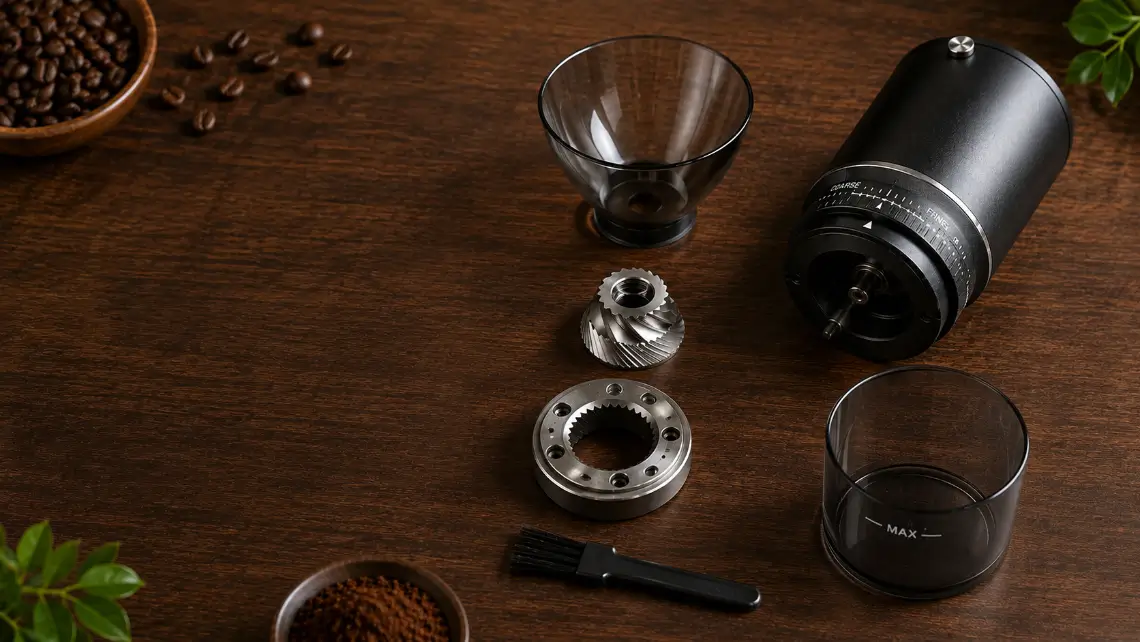
Open the top of any coffee grinder and the parts inside are doing very different jobs — some cut the bean, some control how finely it’s cut, and some exist just to keep static and heat from ruining your grind. Knowing what each component actually does makes it much easier to tell a genuinely well-built grinder from one that just looks the part on a shelf. Here’s every major part, what it’s made of, and why it matters.
The Burrs: Ceramic, Steel, Titanium & Cast Iron
The burrs are the two surfaces that actually crush the beans, and the material they’re made from affects heat, wear, and price.
Ceramic burrs run cooler and resist rust and corrosion, which makes them a common choice in hand grinders. They’re also more brittle — a hard drop can chip them — and they tend to dull more gradually than metal burrs.
Steel burrs are the most common option across price points. Hardened steel holds an edge well, dissipates heat efficiently at higher RPM, and is easy to source as a replacement part.
Titanium-coated burrs are typically steel burrs coated in titanium nitride for extra hardness and wear resistance. They hold their edge longer than plain steel, which is why they show up mostly on premium grinders where longevity justifies the added cost.
Cast iron burrs are the oldest style, heavier and less precise by modern standards. You’ll mostly find them in vintage-style or traditional box mills rather than current precision equipment.

Bean Hopper
The hopper is the container that holds whole beans above the burrs and feeds them down by gravity. Home hoppers typically hold around 200–300g; commercial hoppers can hold several kilograms for continuous café use. Some hoppers add UV-blocking tint or airtight seals to slow bean staling, while single-dose grinders often skip a full-size hopper entirely in favor of a small tray or none at all — beans go in right before grinding.
Grind Adjustment System (Standard & Micrometric)
This is the collar or dial that changes the gap between the burrs, which is what actually sets grind size. A basic adjustment moves in fixed increments (stepped) or along a continuous gradient (stepless) — covered in more depth in our types of coffee grinders guide. Micrometric adjustment refers to a finer-grained version of this system, precise enough to be measured in microns per click or per degree of rotation. It’s the feature that lets espresso drinkers dial in a shot down to a fraction of a turn, rather than jumping between broad settings.
Portafilter Fork
This is the metal bracket or cradle mounted under the grinding chute that holds a portafilter steady while beans grind straight into it. It’s a signature feature of doserless grinders, and better models offer an adjustable or swappable fork to fit different portafilter sizes or dosing cups.
Timer
A built-in timer controls how long the grinder runs, which indirectly controls dose size when a scale isn’t part of the workflow. It’s a common feature on prosumer and commercial doserless grinders that predate — or sit alongside — grinders with a built-in scale for weight-based dosing.
Direct Grinding
This describes a design where ground coffee falls straight from the burrs into the portafilter or container with no holding chamber in between. It’s the component-level explanation of what makes a grinder “doserless” — grounds go from burr to cup in one continuous path, with minimal retention or mixing of old and new coffee.
Anti-Clumping System
Freshly ground coffee builds up static charge, which makes fine particles cling to the chute walls, clump together, and scatter outside the portafilter. Anti-clumping systems address this with ionizing bars, small agitator paddles, or vibration — an automated version of the manual water-drop trick (RDT) some baristas use by hand.
Cooling System
Grinders that run for extended periods — mainly commercial models — need a way to shed heat, since sustained friction at the burrs and motor can affect grind temperature and shorten component life. This usually means a small fan, heat sinks, or a thermal cutoff switch that pauses the motor before it overheats.
Motor & Drive
The motor determines how the burrs are powered and at what speed. Direct-drive motors connect straight to the burrs; gear-reduction motors use gearing to spin the burrs slower while keeping torque high. Lower-RPM, higher-torque motors generally run cooler and are preferred for flat burr espresso grinders, while simpler high-RPM motors are more common in budget models.
Burr Alignment System
This is the mechanism that keeps the two burrs perfectly parallel and centered relative to each other. Even high-quality burrs will grind unevenly if they’re slightly misaligned, so premium grinders include self-centering designs or adjustable alignment screws to correct for manufacturing tolerances and wear over time.
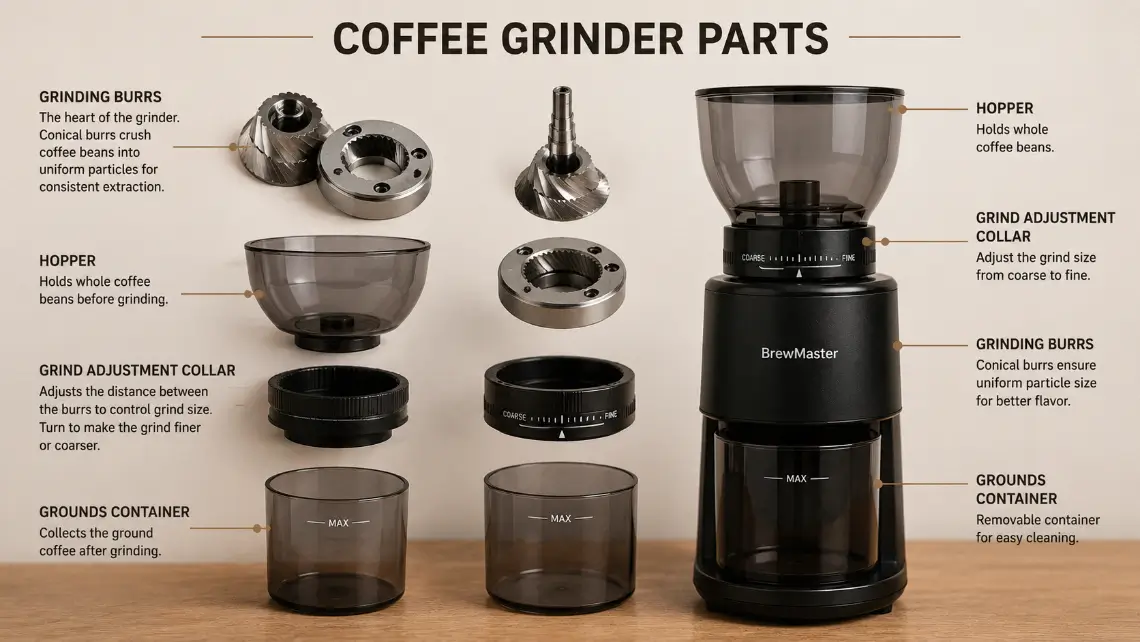
Quick Reference Table: All Grinder Components at a Glance
| Component | What It Does |
|---|---|
| Ceramic Burrs | Run cool, resist corrosion, more brittle |
| Steel Burrs | Most common, durable, easy to replace |
| Titanium Burrs | Steel burrs coated for extra wear resistance |
| Cast Iron Burrs | Heavy, traditional, found in vintage-style mills |
| Bean Hopper | Holds whole beans, feeds burrs by gravity |
| Grind Size Adjustment | Sets the burr gap that determines grind size |
| Micrometric Adjustment | Fine-grained version of grind adjustment, measured in microns |
| Portafilter Fork | Holds the portafilter steady under the grinding chute |
| Timer | Controls grind duration for repeatable dosing |
| Direct Grinding | Grounds pass straight from burr to portafilter, no chamber |
| Anti-Clumping System | Reduces static cling and mess from fine grounds |
| Cooling System | Prevents overheating during continuous use |
| Motor/Drive | Powers the burrs; determines speed and torque |
| Burr Alignment System | Keeps burrs parallel and centered for even grinding |
“People fixate on burr material, but alignment is what actually determines whether you get a consistent grind. A slightly misaligned $500 grinder can underperform a properly aligned $150 one.” — Alex Thompson


